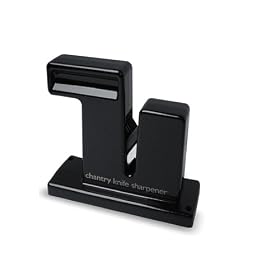

Color: White
Pull-through knife sharpener in white combines modern style with everyday functionality
Reproduces the action of a butcher's steel with spring loaded steel rods
To use, draw the knife between the steel rod 4 or 5 times using enough pressure to rotate the steels
Made in Sheffield, England; on permanent display in New York Museum of Modern Art
Replacement steels available; not recommended for fine edge elite knives or Japanese knives
Combining modern style with everyday functionality, the Messermeister Chantry full metal, pull through knife sharpener in white is a great option for sharpening a knife when a stone is not available--just run a knife blade between the two butcher steels four or five times for a quick sharpening and then get back on task. Designed by Robert Welch, Royal Designer for Industry, the Chantry is on permanent display at the New York Museum of Modern Art. The two butcher steels offer the same hardness, temper and cut as a professional steel. The steels are preset at the optimum angle, spring loaded so as not to damage the knife, and revolve under tension and do not wear away the blade. Made in Sheffield, England, the Chantry also features a cast iron body, replaceable steels, and a lifetime manufacturing warranty. It is not recommended for use with fine edge elite knives or Japanese knives.
This review is from: Messermeister Chantry Knife SharpenerNote that the Chantry sharpener uses a rather unique approach, and does not sharpen a blade like a "standard" sharpener. To understand how this device works, it's interesting to contrast the Chantry with the standard method of keeping a knife sharp:Sharpening: A standard sharpener simply removes small amounts of metal on the edge of the blade to form a smooth, sharp edge with a cross-sectional view that looks like a V.Steeling: Although it's hard to see, with use, the edge of a sharp knife blade can bend, and ultimately curl, which in a cross-sectional view would look like a J. A knife steel is used to straighten the edge, which restores sharpness to the blade (assuming the edge is not otherwise damaged or dull) and extends the life of the knife since no additional metal is removed. When steeling a blade no longer results in sharpness, it's time to sharpen it again.In contrast, the Chantry uses two steel rods configured in a V to "shape" the blade. In this way, it's like steeling. However, the steel rods are grooved. The ultimate effect is that the Chantry creates a blade with very small serrations that are good for sawing through course food, but not particularly good for tasks that require a razor-sharp edge like cutting ripe tomatoes.I recently purchase both this sharpener and the Chef's Choice electric sharpener because they were highly rated in Cooking Illustrated. I definitely prefer the edge the Chef's Choice produces. In general, you want a knife to be sharp enough that a lot of sawing is not required. For example, after I sharpened my Santoku with the Chef's Choice, it sliced through chicken breast like butter. But after using the Chantry, there was some sawing involved....
This review is from: Messermeister Chantry Knife SharpenerI've been using one of these devices for years, on all manner of knives, and I love it. I have found it usually takes 20 to 30 strokes to get a very sharp edge -- one that slices smoothly through tomatoes -- on a chef's knife. Every knife in my drawer is sharp and ready to work thanks to this wonderful tool....
This review is from: Messermeister Chantry Knife SharpenerThis sharpener is easy to use, takes up very little space in my tiny galley kitchen, and actually works well. It has no fussy little pieces to deal with....

Detail Products
Detail Reviews
Click here for more information

»»»Visit Store NOW...
Best price click here
