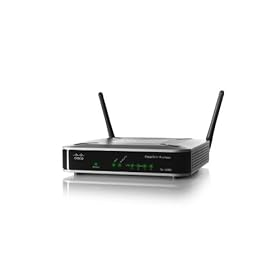

Integrated four-port 10/100 Mbps switch provides quality of service (QoS) and VLAN support
Support for Cisco FindIT Network Discovery Utility
This review is from: Cisco Wireless-N VPN Firewall - RouterOk, after waiting for this to come back in stock for a few weeks, I finally got it. I've had Linksys, D-Link, and Netgear network hardware, and wasn't satisfied by them. Yes, I know Linksys is owned by Cisco, but let's face it, if you know networking, you know they AREN'T the same. Now before I get flack for my title, the setup being easy is relative to your savvy. If you've never heard of VPN, don't know what QOS or SPI stand for and actually mean, this probably isn't the route to take. There are TONS of decent home user level routers that do what you want, and are probably a bit easier to determine what features you want to use or don't want to use. Now, for the rest, this is a decent buy. Not that I'm a CCNA or above, but I know when I don't get what I want out of a router. I also know that I love to tinker with my tech toys, and this gives me the freedom to giggle like a fool while I fiddle with the features. All in all, thumbs up.Pros:* Price. Let's face it; the Cisco Small Business line is a smashing deal. Cisco gear at a decent price? That's not to say that Linksys or Netgear doesn't make their "Professional Series" gear with the same functionality, but I trust Cisco. At ~150 bucks, you can't beat it.* All the nitty gritty features that everyone wants, but no one wants to setup via the CLI, can be done through the web setup interface. In fact, you have no choice (that being said, don't go nuts on this point until you see Cons). * Logging. Yes, logging. Basic, but necessary. The routers I've known didn't have logs available.* Status reports. View how your router's doing. Things going slowly and suspect an attack? You can check your router's logs and the reports to see if things indicate an attack. How many home users can say that?!Cons: * No command line option. At least not that I've read about or seen. Correct me if I'm wrong. I'm not sure how viable this is for a business as this is the case.* Setup can be a bit touchy, though overall it isn't bad. The detecting router portion of it was a bit flaky, but again, not something that was a deal breaker.Conclusion:This is a power users router, or an extremely small business router that doesn't have a network administrator/NOC. Not something I'd implement if you have those things and if you need completely customized configurations. It just won't have all the flexibility or power of a higher scale solution.I'll update this after I use the router more, but thus far, it's neat. We'll see if the Cisco quality came along with the branding on the small business series....
This review is from: Cisco Wireless-N VPN Firewall - RouterThe biggest problem this device has is bad documentation. Although it is a long document, it doesn't say anything, it just repeats the user interface on the device. It doesn't go on to explain things. The second problem is that it is just not ready yet. There are a lot of little glitches, and a few major ones. Currently there is only the first version of the firmware available. You probably want to wait for the next update.Don't consider this unless you have some business networking experience. Don't expect to just plug it in and go. You need to review the many options and make sure they are set correctly. From looking at other reviews, a lot of the other people buying this have troubles because they don't know what a lot of the settings do and have no idea whether it is configured properly. Given the state of documentation, that isn't their fault.Major problems: The QuickVPN client (that you run on your laptops to connect over the VPN) requires Administrator rights to work. From a security point of view, this is anti-security. Also, there are no diagnostics if the QuickVPN doesn't connect so you have no help figuring out if the problem was permissions, bad password, already connected, some intermediate device dropping IPSEC, etc.You need to disable the UDP Flood attack check that is enabled by default. This can block outbound DNS requests and interferes with some web pages and will kill an internal caching DNS server.If you connect to the ISP with a static IP address and the WAN interface disconnects (upstream device reset, power loss, cable pulled), it stays disabled until you manually log in to the RV120W and re-enable it. Obviously, this must be done locally, where you may not have staff to do it.Minor problems: QuickVPN does not give you a local IP address (like L2TP/PPTP) so you may have other issues since your network sees a foreign address. If you try to connect to administer the device over HTTP, it doesn't redirect to HTTPS, but it doesn't work either. The administration interface is sluggish at best. Occasionally the CPU seems to peg at 100% for no apparent reason. This will hurt performance...

Detail Products
Detail Reviews
Click here for more information

»»»Visit Store NOW...
Best price click here
