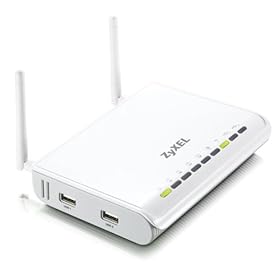

High performance wireless N Gigabit router optimizes multimedia streaming
NetUSB shares USB mass storages and printers wirelessly
Configurable QoS ensures optimal bandwidth for preferred network applications
Friendly user interface for fast function navigation and setup
Online auto-upgrade firmware service for convenient feature enhancements- WPS button for quick and easy wireless security setup
Easy-to-extend wireless network coverage with any existing AP
Net USB shares USB mass storages and printers wirelessly
This review is from: ZyXEL NBG4615 300Mbps Wireless N Gigabit RouterI'm a big fan of ZyXEL stuff, from their 56K modems back in the day, to the Prestige line of ADSL modems that I used to have with my Sprint / Embarq a few years ago. So I was pretty excited about this router.I now live in San Jose, California in a new apartment building, and have AT&T U-verse delivered by fibre that is terminated in my bedroom's walk-in closet. I got this ZyXEL router with the intention of entirely replacing the huge RG that AT&T supplies all of its customers with (2Wire 3800HGV-B), including customers that have a fibre-terminated Fast Ethernet, which is connected to the BROADBAND port on that huge multipurpose RG (instead of the PHONE LINE, as would be the case with xDSL customers). (Note for novice users: This router cannot replace the RG if you have regular AT&T U-verse powered by xDSL, which is what more than 90% of U-verse customers currently have.)I connected this router to my fibre-box, cloned my RG's MAC address (you won't get a DHCP lease without cloning the MAC address of your 2Wire RG for some reason), setup my Static IP allocation under Configuration: Network: LAN: IP, and it all worked after that. With the exception of U-verse TV.To get the TV working, I tried enabling IGMPv1/v2, and after that, TV seemingly started to work, too; yet each channel could only be watched for like 15 seconds, and then the TV box would report that the signal is lost. Supposedly, AT&T U-verse TV requires IGMPv3, as is evidenced by some statistics on the 2Wire RG, but this router only supports v1 and v2, so, I guess I'm out of luck. I then tried to actually disable IGMP all together, as I've figured I only have one TV box, so IGMP on my own network doesn't really make that much sense. The TV box actually still seemed to work for a while even after IGMP was disabled (it didn't seem to work at all prior to IGMP being enabled in the first place), and my dumb GS108 was only reporting activity on two ports (e.g. IGMP must have been indeed off). However, each TV channel would still only work for like 15 seconds, before the TV box claiming that the signal is lost. Disabling the firewall on the router didn't seem to alleviate any of these problems. I tried disabling NAT (I have a bunch of public IPs, so NAT is not needed), however, TV now didn't work at all. (I have to say I'm not very familiar with IGMP yet.)The power consumption is significantly lower than that of 2Wire RG: 2Wire gets around 10W idle, yet this thing gets only 5W. E.g. you get both: considerably lower power consumption, yet considerably higher wired and wireless networks -- impressive. Size-wise, this router is also considerable smaller.Overall, however, I am somewhat disappointed in this router, for the following reasons:* There is no telnet configuration, which I've grown to love with my old Sprint/Embarq Prestige modems.* The LAN setting only has one IP Alias option, I recall even my Prestige modems had 2 aliases.* DHCP Server: Advanced tab wouldn't let you use addresses from the "LAN: IP Alias" tab, saying that they are invalid as they are outside of the "LAN: IP" subnet.* As per above, it looks like DHCP server only supports a single IP subnet. That's just stupid, even the 2Wire RG that was to be replaced allows you to specify either a private or a public IP address for each machine.* No prefilled MAC-address values anywhere whatsoever in the interface; you have to find all the info by hand and manually place it into the tables provided.* No IGMPv3 support, which supposedly seems to be required in order for the U-verse TV to work at all.* Firmware update from the first version (late 2010) to the second version (summer 2011) removes the ability to specify IPv6 on the IPv6 settings page. WTF?* Bandwidth Management for Guest WLAN is a lie -- you provide a single kbps setting, yet your given value only limits downstream, thus your guests can easily saturate your upstream if they wish to, against your instruction, knowledge or desire, and make your connection unusable (saturated upstream would make the fastest connection unusable). I tried the limit of 384 kbps on my 18/1.5 U-verse, and benchmarked 0.34Mbps downstream and 1.4Mbps upstream, e.g. upstream got saturated. There's also no setting of what external IP-address should be used for Guest WLAN (remember, I have a bunch of Static IP addresses).* Other annoying bugs...

Detail Products
Detail Reviews
Click here for more information

»»»Visit Store NOW...
Best price click here
